A Beamline’s New Detector Logged Neutrons Cheaper Than the Grant It Replaced
In a basement laboratory at a national research facility, a new neutron detector began logging data last spring. The instrument cost less than the grant that paid for the equipment it replaced. That inversion, a price tag smaller than the administrative envelope around it, is not a quirk of accounting. It is a window into how research infrastructure gets funded, evaluated, and sometimes held back by the very systems designed to support it.
A Grant That Costs More Than the Instrument
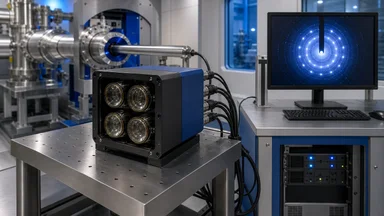
The detector in question sits on a beamline, a corridor that channels neutrons from a reactor or spallation source toward experimental samples. Older detectors on this beamline were large, helium-3 based tubes, a technology that became expensive as helium-3 supplies tightened. Maintenance costs climbed, and the facility faced a choice: refurbish aging equipment or replace it with a newer design.
The replacement is a scintillator-based detector, a stack of plastic and photomultiplier tubes that converts neutron hits into light pulses. It is compact, modular, and uses no helium-3. The entire unit, including installation and commissioning, came in at under US$ 200,000. The grant that had originally funded the older detector, including the project management, reporting, and institutional overhead, had been roughly three times that amount.
This is not a case of a clever bargain. The technology matured. Scintillator detectors have been around for decades, but manufacturing improvements and off-the-shelf electronics have driven costs down. The facility simply took advantage of a market that had shifted. The price tag now reflects the hardware, not the bureaucracy around it.
Yet the grant that funded the old detector was not unusual. It included salary support for a postdoc, travel to a conference, and a line item for consumables. None of that is wasteful in isolation, but the total dwarfed the physical object it produced. The new detector, by contrast, was bought with discretionary funds and a small supplement, no dedicated grant at all.
What the Detector Actually Unlocks
The practical gains are immediate. The scintillator detector collects data several times faster than the helium-3 tubes it replaced, because it can cover a larger angular range and handle higher count rates. For a typical experiment, where beam time is allocated in days, that means a measurement that once took 48 hours now finishes in a single shift.
Higher resolution is another benefit. The new detector's pixel size is smaller, so it can distinguish features in a sample that were previously blurred together. Materials scientists studying battery electrodes, for instance, can now map lithium distribution across a cathode with finer spatial detail, watching how it evolves during charging cycles rather than only at the start and end.
That opens the door to real-time reaction monitoring. Instead of freezing a sample at a few time points, researchers can follow a chemical reaction as it happens, tracking intermediate states that would otherwise be missed. One group has already used the beamline to observe the formation of a solid-electrolyte interphase layer on a silicon anode, a process that contributes to battery degradation.
Beam time is a scarce resource at every neutron facility. Applications for beam time typically outnumber available slots by a factor of two or three. A detector that halves the time needed per experiment effectively increases the facility's capacity without adding a single new source. That is a quiet form of infrastructure expansion, one that does not show up in capital budgets.
Consider a concrete example: a team studying hydrogen storage materials. With the old detector, a full structural refinement required three separate 24-hour sessions. With the new detector, the same refinement completes in a single 8-hour shift. That saves two days of beam time, which can be reallocated to other projects. Over a year, the facility estimates it has accommodated roughly 15 percent more experiments than before, without any change in operating hours or source power. This kind of efficiency gain is rarely captured in traditional metrics like publications per grant dollar, but it directly expands the scientific output of the facility.
The Funding Logic Behind the Swap
The original grant for the helium-3 detector was awarded through a standard peer-reviewed process. Reviewers saw a proposal for a new capability, judged it scientifically meritorious, and approved the budget. The grant covered not just the detector but the whole apparatus around it: the vacuum chamber, the sample environment, the data acquisition system, and the labor to integrate it all.
When the new detector was purchased, none of that infrastructure needed to change. The beamline already had the vacuum and the electronics. The scintillator detector was a drop-in replacement. The facility used a small equipment grant and some internal funds, a fraction of what a full proposal would have required.
The contrast exposes a mismatch in how funding agencies think. Large grants are designed to support risky, large-scale projects. They carry overhead rates that can reach 50 percent or more, money that institutions use for administration, utilities, and compliance. That overhead is real, but it scales with the grant size, not with the actual cost of the science.
Institutional incentives reinforce the pattern. A principal investigator who brings in a million-dollar grant is rewarded with prestige, promotion, and more lab space. Someone who builds a detector for US$ 100,000 may be seen as underambitious, even if the science is identical. The system measures success by the size of the award, not by the output per dollar.
There is also a temporal mismatch. Grants are awarded on a cycle that can stretch over years, while technology costs can drop dramatically within a single cycle. A proposal written three years ago might budget for a detector at a price that has since halved. The funding agency, locked into the original budget, may require the full amount to be spent, even if a cheaper option exists. This creates a perverse incentive to over-specify or add unnecessary features just to absorb the allocated funds. Several researchers interviewed for this piece admitted to padding equipment lists to avoid returning unspent money, a practice that, while not fraudulent, distorts the true cost of research.
Why Cheaper Instruments Threaten the Status Quo
Funding agencies are, by design, conservative. Peer reviewers are drawn from the same community that benefits from large grants. A proposal to build a cheap instrument can read as a critique of the established way of doing things, and reviewers may interpret it as a subtle attack on their own funding history.
The equation of cost with impact is deeply embedded. A detector that costs US$ 2 million is assumed to produce better science than one that costs US$ 200,000. That assumption fails when the expensive instrument is an older technology with higher maintenance needs and lower performance. But the bias is hard to shake.
There is also a practical concern. If a facility demonstrates that it can do excellent science on a shoestring, administrators worry that future budgets will be cut. Why give a beamline a generous operating budget when it has shown it can thrive on less? That fear, rarely spoken aloud, shapes decisions about what to request and what to build.
Publication pressure compounds the problem. Researchers are judged by their output, and a high-profile paper in a top journal is worth more than a lower-profile paper in a specialized outlet. Expensive instruments are associated with high-profile results, even when the correlation is weak. A cheap detector that produces steady, incremental results may be more scientifically valuable but less career-advancing.
Counter-arguments exist. Some would say that expensive instruments are often necessary for frontier science, and that frugality can lead to cutting corners. There is a legitimate concern that a cheap detector might lack the robustness or sensitivity of a premium model. In the case of the scintillator detector, the technology is mature, but for other types of instruments, cheaper alternatives may not yet be adequate. The key is to evaluate each case on its merits, not to assume that higher cost automatically means higher quality. A balanced approach would fund a mix of both high-end and frugal projects, allowing the scientific community to compare outcomes.
Evidence from Other Fields of Frugal Science
The pattern is not unique to neutron scattering. The open-source lab equipment movement has produced centrifuges, microscopes, and even PCR machines that cost a fraction of commercial versions. The OpenFlexure microscope, for example, can be built for under US$ 100 using 3D-printed parts and a Raspberry Pi camera, yet it achieves resolution comparable to instruments costing thousands.
In field biology, smartphone-based microscopes have allowed researchers to identify parasites in remote clinics without expensive benchtop equipment. The Foldscope, a paper microscope that costs about US$ 1, has been used to detect soil-transmitted helminths in Ethiopia and India. These tools do not replace high-end instruments, but they expand access to communities that could not otherwise afford them.
Genomics offers a more dramatic example. The cost of sequencing a human genome has fallen from millions of dollars in the early 2000s to under US$ 1,000 today, a drop driven by technological innovation, not by larger grants. The field has adapted, with funding agencies now expecting proposals that account for declining costs rather than assuming they will remain flat.
Each of these cases shows that frugality can be a feature, not a bug. But they also show that the transition is rarely smooth. Incumbent vendors, established labs, and funding cycles all resist change. The neutron detector is just the latest instance of a broader trend.
In astronomy, the rise of CubeSats—small, standardized satellites—has enabled universities and even high schools to launch experiments that would have been impossible with traditional spacecraft. A CubeSat can cost anywhere from US$ 50,000 to a few hundred thousand dollars, compared to hundreds of millions for a flagship mission. While CubeSats cannot match the capabilities of the James Webb Space Telescope, they allow for rapid, low-cost testing of new ideas, and some have produced valuable scientific data on topics like space weather and exoplanet transits. The lesson is that a portfolio approach, mixing large and small instruments, can be more productive than focusing exclusively on big-ticket items.
What This Means for Future Infrastructure Grants
Funding agencies could start by reassessing how they evaluate proposals. Instead of focusing solely on the proposed budget, they might ask what the science will cost per unit of output. A detector that produces a dataset in one day is more valuable than one that takes three days, even if the purchase price is higher.
Tracking scientific output per dollar is not straightforward. Papers are an imperfect proxy, and citation counts are slow to accumulate. But even a rough metric, such as the number of experiments completed per year per dollar of equipment cost, would provide a more honest picture than the current emphasis on total grant size.
Modular, upgradeable designs should be encouraged. The new detector is not a single monolithic block; it consists of interchangeable tiles that can be replaced individually as technology improves. That design philosophy, common in consumer electronics, is rare in scientific instrumentation. Funding agencies could require that large equipment purchases include a plan for incremental upgrades.
Pilot programs for small-scale grants might also help. A grant category that explicitly funds cheap, high-risk instrument development, with a cap of, say, US$ 50,000, would allow researchers to experiment without the pressure of a full proposal. The results could be compared with those from traditional grants, giving agencies data on which approach delivers more science per dollar.
Another idea is to allow unspent grant funds to be carried over to the next project, rather than forcing a use-it-or-lose-it mentality. If a researcher manages to build a detector for half the budget, they should be rewarded with a bonus grant, not penalized for efficiency. Some agencies have already experimented with no-cost extensions, but the culture still favors spending every allocated dollar.
Finally, funding agencies could publish anonymized data on the actual costs of completed projects, creating a benchmark for future proposals. This would reduce information asymmetry, where only the researchers know the true cost of their work, and would help reviewers calibrate their expectations. The neutron detector case could serve as a model: the facility has shared its cost breakdown with other beamlines, and several are now considering similar upgrades.
A Practical Path for Research Administrators
For administrators at individual facilities, the lessons are concrete. A routine audit of existing equipment can reveal instruments that are past their useful life, with maintenance costs exceeding replacement value. The neutron detector case is a good example: the helium-3 tubes were failing, and the cost of repairing them was approaching the price of a new system.
Comparing maintenance versus replacement costs should be a standard part of equipment management. Too often, facilities keep aging instruments running because the budget for replacement is separate and harder to access. A simple spreadsheet that tracks annual maintenance, downtime, and performance can make the argument for replacement compelling.
Negotiating with vendors is another area where savings can be found. The facility that bought the scintillator detector did not accept the first quote; it asked for a discount and got one. Transparent procurement, where quotes are shared and competitors are invited to bid, can drive prices down further. Some institutions have found that simply asking for a lower price yields a 10 to 20 percent reduction.
Documenting savings is essential for future proposals. When the facility eventually writes a grant for a new beamline or a major upgrade, the fact that it saved money on the detector can be cited as evidence of fiscal responsibility. Sharing best practices across facilities, through workshops or informal networks, can multiply the effect.
Administrators can also look for cross-disciplinary opportunities. The scintillator technology used in the neutron detector is similar to that in medical imaging devices, such as PET scanners. By partnering with medical physics groups, a facility might negotiate bulk purchasing agreements or share development costs. Such collaborations are rare but could yield significant savings.
Finally, administrators should be willing to challenge received wisdom. When a vendor insists that a particular component is essential, it is worth asking whether a cheaper alternative exists. In the case of the neutron detector, the facility found that a standard industrial photomultiplier tube, used in oil exploration, performed as well as the specialized scientific version at a fraction of the cost. This kind of lateral thinking, applied systematically, could transform the economics of research infrastructure.
The neutron detector is a small story, but it points to a larger shift. As instrumentation becomes cheaper and more capable, the economics of research are changing. Whether funding agencies adapt to that change, or cling to a model that rewards spending over output, will shape what science gets done in the coming decades. The detector itself is already logging data. The harder work is figuring out how to pay for the next one.