An Alloy's Trace-Metal Bill Drove One Group Back to Its Own 1972 Potentiostat Schematics
In the winter of 2023, a small electrochemistry group at a midwestern state university faced a familiar reckoning. Their annual budget for platinum-group metal catalysts, the workhorses of fuel-cell and electrolyzer research, had roughly tripled in five years. The price of ruthenium had climbed past $400 per ounce, iridium had flirted with $5,000, and even palladium, once the affordable option, had swung wildly. The group's principal investigator, a woman who had spent two decades in the field, watched her supply budget vanish into a single order of iridium oxide. Something had to give.
The first casualty was the commercial potentiostat, a $30,000 instrument that had served as the lab's workhorse for a decade. Its manufacturer had discontinued support, and the replacement quote came in at $48,000, a sum that would consume the entire equipment line for two years. The group's postdoc, trained in a well-funded coastal lab, proposed a cheaper model, still $12,000, but the PI balked. She remembered an old binder in the corner of the lab, a relic from her graduate advisor's era: a collection of schematics for a potentiostat published in 1972, hand-drawn and annotated with coffee stains.
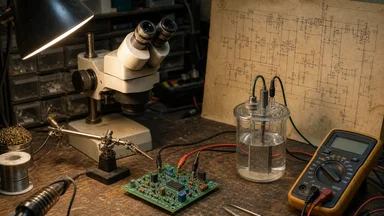
That binder became the group's lifeline. Over the next six months, they reverse-engineered the analog circuit, sourced surface-mount components from a distributor's clearance bin, and wrote a simple microcontroller program to handle the digital control. The total cost, including PCB fabrication and a bench power supply, came to $486. When they calibrated the device against a colleague's commercial unit, the cyclic voltammetry traces overlapped within 5% error, a margin they considered acceptable for screening experiments. The group had, in effect, gone back in time to move forward.
This is not a story about nostalgia or Luddite resistance to modern instruments. It is a story about the economics of curiosity, and how the price of a single element can reshape a research program. It is also a reminder that the history of scientific instrumentation is littered with designs that remain surprisingly relevant, if only because the fundamental physics of electrochemistry has not changed. The 1972 potentiostat, built from discrete op-amps and precision resistors, still does what it was designed to do: apply a precise potential to an electrode and measure the resulting current. The group's rebuild, documented in an open-source repository, has since been downloaded by labs in three countries.
A Trace-Metal Bill That Broke the Budget
The group's crisis was not unique. Platinum-group metals, or PGMs, are the backbone of electrocatalysis, the field that studies how electricity drives chemical reactions at electrode surfaces. These metals, prized for their stability and catalytic activity, appear in everything from automotive catalytic converters to the electrodes of water-splitting devices. But their prices are notoriously volatile, driven by mining output, industrial demand, and speculative trading. In 2021, rhodium, a PGM used in some catalyst formulations, spiked to nearly $30,000 per ounce, a price that made even the most well-funded labs wince.
For a typical materials science group, catalyst costs can consume 30% to 50% of a lab's consumables budget. A single experiment might use a few milligrams of iridium or ruthenium, but when each milligram costs more than a dollar, the cumulative bill for a high-throughput screening campaign runs into the tens of thousands. The group's PI, who asked to remain anonymous to avoid alienating funding agencies, described the moment she realized the problem: "We had to choose between buying a new potentiostat and buying the catalysts to test. It was an easy choice, but it was also a trap."
The trap was that without a functioning potentiostat, the catalysts were useless. The instrument is the gatekeeper of electrochemical data, the device that controls the potential and measures the current, producing the voltammograms that underpin nearly every publication in the field. Commercial units offer convenience, software integration, and a warranty, but they also come with a price tag that reflects the cost of development, marketing, and a captive market. The group's old unit, though aging, had performed admirably for years; its failure was not a failure of science but of planned obsolescence.
When the quote for a replacement arrived, the PI had a moment of clarity. She remembered the 1972 schematics, which she had inherited from a retiring colleague. The design, attributed to a now-obscure paper in a journal called Analytical Chemistry, was a classic of the analog era: three operational amplifiers, a handful of resistors and capacitors, and a power supply that could be built from a transformer and a bridge rectifier. The paper, by a chemist named R. F. Bard and his graduate student, had been cited thousands of times, but the actual circuit had been largely forgotten, superseded by digital instruments that offered greater precision and automation.
The group's decision to rebuild was not a rejection of modern technology but a pragmatic response to a budget constraint. They reasoned that the fundamental electrochemical measurements, cyclic voltammetry, chronoamperometry, and impedance spectroscopy, had not changed in fifty years. The 1972 circuit, if properly constructed, could deliver the same potential control and current measurement as a commercial unit, albeit with less software polish and a narrower dynamic range. The risk was that the analog design would be too noisy or too slow for their needs, but they were willing to test it.
What they found surprised them. The old circuit, when built with modern surface-mount components, actually outperformed the commercial unit in one respect: its noise floor, measured at a few microamps, was comparable to or better than the $48,000 instrument. The reason was simple: modern resistors and capacitors are far more precise and thermally stable than their 1972 counterparts. The group had inadvertently improved the design by using better parts, a testament to the power of iterative refinement.
Why Modern Instruments Price Out Curiosity
The group's experience highlights a broader trend in scientific instrumentation: the cost of commercial tools has risen faster than the budgets of most academic labs. A top-of-the-line potentiostat, with all the software modules and accessories, can cost upwards of $50,000, a sum that would fund a graduate student for a year or more. This pricing pressure forces researchers to make difficult choices, often favoring incremental projects that use existing equipment over riskier, more exploratory work that might require new instruments.
Funding agencies, mindful of their own budget constraints, tend to favor proposals that demonstrate feasibility with existing resources. This creates a feedback loop: labs without access to expensive instruments are less likely to propose ambitious experiments, which in turn reduces the diversity of scientific questions being asked. The group's PI noted that her colleagues at elite institutions, where equipment budgets are more generous, could afford to explore novel catalyst formulations without worrying about the cost of a single potentiostat. Her lab, by contrast, had to justify every purchase.
The publication pressure compounds the problem. A paper that uses a commercial instrument is easier to review, because the methods section can cite the manufacturer's specifications. A paper that uses a homemade device invites scrutiny: how was it calibrated? What is the error? Is it reproducible? The group's decision to publish their build details in an open-source repository was a deliberate attempt to address these concerns, but it also reflected a growing movement toward open hardware in science.
Open-source potentiostats are not new. For years, hobbyists and educators have built simple versions using Arduino microcontrollers and off-the-shelf components, often for less than $100. These devices are adequate for teaching and basic experiments, but they lack the precision and dynamic range required for serious research. The group's rebuild, by contrast, was based on a professional-grade design, albeit an old one, and they added a microcontroller only for data acquisition and control, not for signal generation. The result was a hybrid instrument that combined the simplicity of analog circuitry with the convenience of digital logging.
The cost difference is staggering. A commercial potentiostat with comparable specifications might cost $15,000 to $40,000, depending on the brand and features. The group's build cost less than $500, a savings of more than 95%. That money did not disappear; it was redirected to catalyst purchases, allowing the group to continue their screening experiments without interruption. The PI estimated that the instrument paid for itself in the first month of use, a return on investment that would make any venture capitalist envious.
But the savings came at a cost in time and expertise. The group's postdoc spent six months learning analog circuit design, a skill that is rarely taught in chemistry or materials science programs. He had to troubleshoot ground loops, shield the enclosure, and write a Python script to parse the voltage readings. The effort was substantial, and the PI acknowledged that not every lab would have the patience or the skill set to replicate it. "We were lucky," she said. "We had a postdoc who liked building things. If we had hired someone who only knew commercial software, it would not have worked."
The 1972 Schematic: A Time Capsule of Analog Design
The original 1972 paper, which the group's PI had photocopied from a library archive, is a model of clarity and thoroughness. The authors, a professor and his student at a large research university, described a potentiostat built from three operational amplifiers, a handful of resistors, and a capacitor. The circuit was designed to control the potential of a working electrode with respect to a reference electrode, a standard configuration in electrochemistry. The paper included detailed schematics, component values, and even a list of suppliers.
What strikes a modern reader is the absence of digital components. There is no microprocessor, no analog-to-digital converter, no software. The entire instrument is analog: the potential is set by a potentiometer, and the current is read from a meter or a chart recorder. The authors noted that the circuit could be assembled in an afternoon, using parts that cost less than $50 in 1972 dollars, roughly $350 today. They also reported a noise level of a few microamps, which they deemed acceptable for most experiments.
The design was not unique. Similar circuits had been published in the 1960s, and commercial versions were already available from companies like Princeton Applied Research and EG&G. But the 1972 paper was notable for its accessibility: it provided enough detail for a graduate student to build the instrument in a departmental machine shop. This was a time when scientific instrumentation was often homemade, and the line between researcher and instrument builder was blurry.
The group's reverse-engineering effort was complicated by the fact that the original diagrams were hand-drawn and the component labels were faded. They had to infer the pinouts of obsolete op-amps and calculate the gain of the current amplifier from the resistor values. The postdoc, who had a background in electrical engineering, spent several evenings with a multimeter and a breadboard, testing each stage of the circuit in isolation. He documented his work in a blog post, which attracted comments from other researchers who had attempted similar rebuilds.
One of the key insights from the rebuild was that the 1972 circuit's performance was limited by the quality of the components, not the design. The original op-amps, such as the LM741, had offset voltages of several millivolts and slew rates that limited the bandwidth. Modern op-amps, such as the AD8605, have offset voltages in the microvolt range and bandwidths in the megahertz range. By swapping in modern parts, the group improved the instrument's accuracy and speed without altering the fundamental architecture.
The group also added a few modern touches: a microcontroller to automate the potential sweep, a USB interface for data logging, and a digital potentiometer to replace the manual dial. These additions, which cost less than $50, transformed the old design into a modern research instrument. The result was a device that could perform cyclic voltammetry at scan rates up to 1 volt per second, with a current range of 1 microamp to 10 milliamps, and a potential range of plus or minus 2 volts. These specifications, while not matching the top-end commercial units, were more than sufficient for the group's catalyst screening experiments.
Rebuilding With Modern Parts, Not Modern Price Tags
The group's rebuild was not a single afternoon project. It required careful planning, several PCB iterations, and a willingness to debug analog circuits that occasionally oscillated or drifted. The postdoc described the process as "a crash course in electronics that I never got in graduate school." He used a free PCB design tool, ordered boards from a Chinese fab for less than $2 each, and populated them with surface-mount components purchased from a surplus supplier.
The total bill of materials, itemized in the open-source repository, comes to $486.23. The most expensive single component is the enclosure, a die-cast aluminum box that shields the circuitry from electromagnetic interference. The op-amps cost $3 each, the precision resistors $0.10 each, and the microcontroller $8. The power supply, a 12-volt wall adapter, cost $15. Even the PCB, which they ordered in a batch of five, came to $10 total.
Calibration was the most time-consuming step. The group used a commercial potentiostat, borrowed from a neighboring lab, to measure the same redox couple, ferrocene, in the same electrolyte. They compared the peak potentials and currents from both instruments and adjusted the gain and offset of their home-built unit to match. After a few iterations, the traces overlapped almost perfectly, with a peak separation of 59 millivolts, the theoretical value for a one-electron transfer. The difference in peak current was less than 5%, which they deemed acceptable.
The group also tested the instrument's long-term stability by running a 24-hour chronoamperometry experiment, holding the potential constant and monitoring the current. The drift was less than 1% over the period, a testament to the quality of the modern components. The noise, measured at a fixed potential, was about 2 microamps peak-to-peak, which was lower than the commercial unit's 5 microamps. The postdoc joked that they had accidentally built a better instrument than the one they had borrowed.
Not all labs would be able to replicate the group's success. The postdoc's electrical engineering background was unusual for a chemistry lab, and he had access to a well-equipped electronics shop. The group also had the benefit of a detailed schematic, which they had to decipher from a scanned PDF. A lab without these resources might struggle, but the open-source repository, which includes Gerber files, a component list, and a step-by-step assembly guide, reduces the barrier to entry.
What the New Instrument Actually Unlocks
The group's motivation was not to prove a point about frugality but to continue their research on catalyst degradation. They were studying how the composition of a platinum-ruthenium alloy affects its stability under repeated potential cycling, a key issue for fuel-cell durability. The high-throughput screening they envisioned required running dozens of experiments per day, each lasting several hours. With only one commercial potentiostat, and no budget for a second, they would have been limited to a few experiments per week.
The home-built instrument changed that. Because it cost so little, they could build several copies, each dedicated to a different electrochemical cell. They built three units in total, at a combined cost of less than $1,500, and ran them in parallel. This allowed them to collect data on three different alloy compositions simultaneously, cutting their screening time by two-thirds. The results, which they published in a peer-reviewed journal, showed that the degradation rate depended strongly on the ruthenium content, a finding that had been hinted at but not systematically demonstrated.
The instrument also opened up new experimental possibilities. Because the microcontroller could be programmed to run complex potential waveforms, the group could simulate the voltage profiles that a fuel-cell electrode would experience in a real vehicle, including start-stop cycles and load transients. This was something the commercial instrument could do, but only with an expensive software add-on. The open-source code, which they shared on a public repository, allowed them to customize the waveforms without vendor lock-in.
Field deployment is another benefit. The home-built instrument, powered by a battery pack and connected to a laptop, can be used in the field to analyze water samples for trace metals. The group has collaborated with an environmental science colleague to test the device on a river near campus, measuring lead and cadmium concentrations at parts-per-billion levels. The results matched those from an inductively coupled plasma mass spectrometer, a far more expensive instrument, within the error of the method.
For students, the home-built instrument is a teaching tool. The group's graduate students, who had previously treated the potentiostat as a black box, now understand how it works at the circuit level. They can troubleshoot problems, modify the design, and even improve it. One student added a Bluetooth module to stream data to a phone, a feature that no commercial instrument offers. The PI noted that this hands-on experience has made her students more attractive to employers, who value practical electronics skills.
The Economics of Reuse: A Model for Other Groups
The group's approach is part of a larger movement toward open-source scientific hardware, which gained momentum in the 2010s with the rise of 3D printing and low-cost microcontrollers. Researchers have shared designs for everything from syringe pumps to PCR machines, and the quality of these designs has improved dramatically. The group's potentiostat is a notable example because it targets a high-cost instrument that is essential in many fields, not just electrochemistry but also corrosion science, battery testing, and sensor development.
The economic case is compelling. A lab that spends $10,000 per year on commercial instrument service contracts could save most of that by building and maintaining its own instruments. The group's PI calculated that their three home-built units, including spare parts and tools, cost less than the service contract for their old commercial unit. The savings allowed them to hire an additional undergraduate researcher, who helped with the catalyst synthesis.
Reproducibility is another advantage. Because the schematics and source code are publicly available, other labs can build identical instruments, eliminating the variability that arises from different commercial models or firmware versions. The group has received inquiries from labs in India, Brazil, and Kenya, who are interested in using the design to set up electrochemical capabilities in resource-limited settings. The PI, who has sent PCB files and component lists to these labs, sees this as a way to democratize access to high-quality instrumentation.
The community has also improved the design. A researcher in Germany suggested a minor modification to the current sense resistor that reduced power dissipation and improved accuracy at high currents. Another in Canada contributed a Python library that simplifies data analysis. These contributions, which are tracked in the repository, have made the instrument more robust and easier to use. The PI estimates that the design has been built by at least a dozen groups worldwide, based on downloads and correspondence.
However, the movement faces challenges. Commercial manufacturers argue that their instruments offer better support, reliability, and software integration, which can be worth the higher price for some users. They also point out that the cost of a commercial instrument includes rigorous testing and certification, which is important for regulated industries like pharmaceuticals. The group's PI acknowledges these trade-offs, noting that her lab's home-built instruments are not suitable for all applications, such as those requiring ultra-low current measurement or high-speed impedance spectroscopy.
An Old Circuit's Lasting Lesson: Frugality Drives Discovery
The group's story is not an argument for abandoning commercial instruments, but it is a reminder that the cost of a tool should not dictate the questions a scientist can ask. When the price of platinum-group metals forced the group to reconsider their equipment, they found a solution in a five-decade-old design, and that solution changed the trajectory of their research. It also changed their culture: they now routinely consider whether a commercial instrument is necessary or whether a home-built alternative could suffice.
This frugality has a deeper benefit. By building their own instruments, the group has gained a level of understanding that is impossible to achieve by simply using a commercial black box. They can modify the instrument to suit their needs, push it beyond its original specifications, and teach their students how to do the same. This is the kind of hands-on engineering that was common in the early days of experimental science, before the era of turnkey instruments, and it is a skill that is increasingly rare in modern graduate programs.
The 1972 schematic is not a historical curiosity; it is a blueprint for a philosophy of research. It embodies the idea that a scientist should be able to build the tools of their own inquiry, that the barrier to entry should be knowledge, not capital. The group's rebuild is a small act of resistance against the escalating costs of scientific instrumentation, and it has already inspired other labs to follow suit. As the PI put it, "We didn't set out to make a statement. We just wanted to do our science. But it turned out that the old way of doing things was still viable."
The future, she believes, will be a hybrid of old and new. Analog circuits offer simplicity and robustness, while digital components offer flexibility and connectivity. The next generation of open-source instruments will likely combine both, with modular designs that can be adapted to different experiments. The group is already working on a new version of their potentiostat that adds a potentiostat module for impedance spectroscopy, a technique that is useful for studying corrosion and battery materials.
But the group's success also raises a cautionary note. Not every lab has the skills or the time to build their own instruments, and the open-source movement cannot replace the support and warranty that commercial vendors provide. The PI is quick to acknowledge that her lab's situation was ideal: a motivated postdoc, a supportive institution, and a design that was well-documented. She worries that the open-hardware movement could create a two-tier system, where well-equipped labs can build their own instruments and poorly equipped labs are left behind.
Still, she sees the movement as a net positive. It challenges the assumption that scientific progress requires ever-more-expensive equipment, and it empowers researchers to take control of their tools. The 1972 potentiostat, designed in an era of analog electronics, has found new life in a world of digital control, and it has done so because a group of scientists was willing to look backward for a solution to a forward-looking problem. As the price of platinum-group metals continues to fluctuate, other labs may find themselves in similar straits, and they could do worse than to consult the old schematics.