Fifty Years of Dutch Elm Disease Inoculation Trials Redrew How Forest Pathologists Read Fungal Spore Traps
In the 1970s, forest pathologists faced a puzzle: their spore traps were clogged with fungal spores, yet many of the elms they were monitoring remained healthy. The traps, simple sticky slides or rotorod samplers, couldn't distinguish between the pathogen that causes Dutch elm disease and the harmless fungi that rode the same air currents. The result was a chronic overcount of disease risk, and it took a series of deliberate, controlled inoculations of healthy elms to reveal how badly the traps were lying.
The Spore Trap That Lied
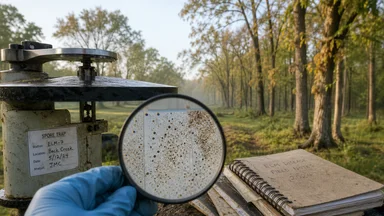
Early spore traps were indiscriminate collectors. A rotorod sampler spinning through the air might capture thousands of spores per cubic meter, and a diligent technician would dutifully count them under a microscope. But those counts were often meaningless for predicting disease. The traps couldn't tell a viable, pathogenic spore of Ophiostoma ulmi from a dead or benign relative. They couldn't account for the fact that many spores never land on a suitable host, and even if they do, they might not find the wound or beetle gallery that allows infection.
The result was a systematic overestimation of infection risk. A spike in total spore count might trigger a costly fungicide application or a panic about an impending epidemic, only for the trees to remain healthy. Conversely, a low count might lull managers into complacency, even as the disease spread silently through root grafts. The traps were generating noise, not signal.
Part of the problem was that the traps were designed for a different purpose. They had been adapted from agricultural settings, where they monitored airborne pollen or fungal spores of crops like wheat. In those contexts, the correlation between spore counts and disease was often tighter because the host plants were densely planted and genetically uniform. But elms in a park or a woodland are scattered, and the disease depends on beetle vectors that are themselves patchy in space and time.
As one pathologist put it, the traps were "counting raindrops to predict a flood" without knowing which clouds carried water. The field needed a way to calibrate the instrument, to learn what a given count actually meant for the trees. That calibration came from a series of inoculation trials that deliberately introduced the pathogen into healthy trees and watched what happened next.
Inoculation Trials: The Controlled Sabotage
Inoculation trials are the forest pathologist's equivalent of a controlled experiment. Researchers selected healthy elms, often in research plots in the UK and the Netherlands, and injected a known concentration of Ophiostoma ulmi spores directly into the xylem. They varied the dose, the timing, and the strain of the fungus. Then they waited, recording symptom onset, pathogen spread, and the appearance of spores in the air around the trees.
These trials were not gentle. A tree injected with a high dose of the fungus might show wilting within weeks, its leaves curling and browning as the pathogen clogged the water-conducting vessels. Lower doses might produce only localized symptoms, or none at all. By comparing the fate of inoculated trees with the spore counts from nearby traps, researchers could begin to map the relationship between airborne spores and actual disease.
The trials were conducted over several decades, from the 1970s into the 1980s, at sites like the Forest Research Station in Alice Holt, England, and the Dorschkamp Research Institute in Wageningen, the Netherlands. They involved thousands of trees, and they produced a wealth of data on how the disease progresses. But the most important finding was not about the disease itself. It was about the traps.
In trial after trial, the traps recorded high spore counts long before any visible symptoms appeared in the surrounding trees. Sometimes, the counts were high even when no new infections were occurring at all. The traps were picking up spores that had blown in from distant sources, or spores that were being produced by the fungus growing in dead wood but were not finding a way into a living tree. The correlation between trap counts and disease incidence was weak at best.
Why Traps Overcounted: The Biology of Spores
The overcounting had a biological basis. First, the beetle vectors, elm bark beetles in the genus Scolytus, carry a mix of fungal species on their bodies. Some are pathogenic to elms, but many are not. When a beetle emerges from a diseased tree, it may carry spores of Ophiostoma ulmi alongside spores of harmless mold. The trap cannot tell the difference.
Second, the pathogenic fungus itself produces spores in two forms: sticky spores that are spread by beetles, and dry spores that are released into the air. The dry spores are more likely to be caught by a trap, but they are also less likely to cause infection, because they need to land in a fresh wound to establish. The sticky spores, which are the more effective inoculum, often never become airborne.
Third, weather plays a role. A rain shower can wash spores out of the air, reducing counts even as infection risk rises. A dry, windy day can loft spores from distant sources, inflating counts without any local disease. Spore viability also matters: a spore that has been desiccated by a day of sun may be dead on arrival, yet the trap still counts it.
The trials helped researchers sort through these confounding factors. By tracking the fate of inoculated trees, they could identify which spore species were actually associated with disease. They found that the ratio of pathogenic spores to total spores was a far better predictor of infection risk than the raw count alone. A trap that caught a thousand spores, of which only ten were Ophiostoma, indicated a lower risk than a trap that caught a hundred spores, of which fifty were the pathogen.
Rewriting the Reading Rules
By the late 1980s, a consensus was emerging. Pathologists began to abandon raw spore counts in favor of ratio-based metrics. Instead of asking "how many spores are in the air?", they asked "what fraction of those spores are the pathogen?" This shift was subtle but profound. It changed the way traps were deployed, the way data were analyzed, and the way risk was communicated to forest managers.
One of the first practical changes was the standardization of trap placement. In the early days, traps were often placed wherever convenient—near a path, at the edge of a clearing, or just outside the lab window. This led to wildly inconsistent results, as the local microclimate and the distance to potential spore sources varied enormously. The trials revealed that traps needed to be positioned at a consistent height and distance from the trees, usually within the canopy or just above it, to capture the spores that were actually moving through the infection zone. They also needed to be placed in multiples, so that variation between individual traps could be averaged out.
Another change was the development of species-specific detection methods. While the early traps relied on visual identification of spores under a microscope, which was time-consuming and error-prone, the new approach used selective media or molecular techniques to identify the pathogen among the thousands of other spores. This was a major advance, as it allowed researchers to quickly and accurately measure the ratio of interest. It also opened the door to automated monitoring, where traps could be analyzed in near real-time.
But the shift to ratio-based analysis was not without its critics. Some argued that the ratio was too conservative, that it might miss early signs of an outbreak when the pathogen was still rare. Others pointed out that the ratio could be distorted by a sudden influx of harmless spores, which would dilute the signal. These were valid concerns, and they prompted further refinements. Researchers began to combine the ratio with other indicators, such as the presence of beetle vectors or the proximity of known infected trees, to create a more holistic risk assessment. They also started to use statistical models that could weight the ratio by the total spore load, recognizing that a high ratio in a low-count environment was different from a high ratio in a high-count environment.
The result was a more nuanced understanding of the relationship between airborne spores and disease. It was no longer a simple matter of "more spores, more risk." Instead, the risk depended on the species composition, the viability of the spores, and the availability of suitable infection sites. The traps were no longer just counting machines; they were part of a complex monitoring system that required careful interpretation.
Beyond Elms: The Method Spreads
The lessons from the elm trials did not stay in the elm groves. As the 1990s and 2000s brought new threats to other tree species, pathologists turned to the same approach to understand and monitor them. One of the most prominent examples was Xylella fastidiosa, the bacterium responsible for olive quick decline syndrome in Italy and Spain. Unlike the fungal spores of Dutch elm disease, Xylella is spread by xylem-feeding insects, and it does not produce airborne spores. Yet the principle of calibration remained: researchers needed to know what the presence of the bacterium in insect vectors or in plant tissue meant for the risk of spread. They used controlled inoculation trials on olive trees to establish the relationship between bacterial load and symptom development, and they applied the same ratio-based logic to their monitoring data.
Another example is sudden oak death, caused by Phytophthora ramorum. This pathogen produces sporangia that release zoospores, which are waterborne rather than airborne, but the monitoring challenges are similar. The traps used in oak forests are often placed in streams or rain collectors, and the raw counts of zoospores can be highly variable. Inoculation trials on oaks and other hosts have helped researchers identify which spore stages are most infectious and how to interpret the counts in relation to disease risk. The ratio of P. ramorum to total Phytophthora species has become a key metric in monitoring programs in California and Oregon.
The method also spread to vineyards, where powdery mildew and downy mildew are perennial threats. Grape growers had long used spore traps to decide when to apply fungicides, but the traps were notoriously unreliable. The Dutch elm disease experience encouraged researchers to develop species-specific traps and to use the ratio of pathogen spores to total spores as a trigger for treatment. This has led to more precise spraying schedules, reducing fungicide use while maintaining control. In some regions, this approach has been integrated into decision support systems that combine spore counts with weather forecasts and vine phenology.
Counter-Arguments and Trade-offs
Despite the success of the ratio-based approach, it is not a panacea. There are situations where raw counts are still useful, particularly when the pathogen is the dominant species in the air. For example, during a severe outbreak, the ratio may be so high that the distinction between ratio and count is academic. In such cases, the raw count can provide a quick and simple warning. Some pathologists argue that the shift to ratios has made monitoring more complex and expensive, requiring specialized equipment and expertise that are not available in all regions. They point out that in low-resource settings, a simple sticky trap and a microscope may be the only tools available, and asking for molecular analysis is unrealistic.
There is also the question of temporal resolution. Spore traps typically collect over a period of days or weeks, and the ratio is an average over that time. This can mask short-term spikes in pathogen spore concentration, which might be important for understanding infection events. Inoculation trials have shown that a single day of high spore release can be sufficient to cause infection, but the ratio over a week might not reflect that. To address this, some researchers have developed continuous spore samplers that provide hourly data, but these are costly and require constant maintenance.
Another trade-off is the balance between sensitivity and specificity. A ratio-based approach is highly specific, because it focuses on the pathogen of interest. But it may be less sensitive, because it can miss the early stages of an outbreak when the pathogen is still rare. In contrast, a raw count is highly sensitive, because it captures everything, but it is not specific. The optimal approach depends on the goal of the monitoring. If the goal is to detect an emerging disease early, a raw count might be better. If the goal is to avoid unnecessary treatments, a ratio-based approach is preferable.
These trade-offs have led to a hybrid approach in many monitoring programs. Managers use raw counts to trigger initial alerts, then use the ratio to decide whether to act. This two-stage process is now common in the management of sudden oak death and Xylella. It reflects the reality that no single metric is perfect, and that the best monitoring systems are those that combine multiple sources of information.
The Legacy of the Trials
The inoculation trials of the 1970s and 1980s were a turning point in forest pathology. They taught the field that spore traps are not simple instruments; they are complex tools that require careful calibration and interpretation. The trials also demonstrated the value of controlled experiments in understanding disease dynamics. By deliberately introducing the pathogen into trees, researchers could isolate the variables that mattered and test hypotheses under controlled conditions. This approach has become a standard part of the pathologist's toolkit, used not only for elms but for a wide range of plant diseases.
The legacy of the trials is visible in the way modern monitoring programs are designed. They are no longer just about counting spores; they are about understanding the ecology of the pathogen and its vectors. They integrate data from multiple sources, including weather, host distribution, and vector activity. They use statistical models to predict risk, rather than relying on simple thresholds. And they are continuously refined as new data come in, just as the original trials were refined over the years.
For the elms themselves, the trials did not save them from the ravages of Dutch elm disease. The disease continues to kill trees, and the battle is ongoing. But the trials did save something else: the credibility of spore trapping as a monitoring tool. Without the calibration provided by the inoculation trials, spore traps might have been abandoned as useless, and the field would have lost a valuable technique. Instead, the traps have been repurposed and refined, and they now play a crucial role in the fight against some of the most devastating plant diseases of our time.
As we face new threats, from climate change to global trade, the lessons of the elm trials are more relevant than ever. They remind us that we cannot simply count the things we see; we must understand what they mean. The spore trap, once a crude collector of airborne debris, has become a sophisticated sentinel, thanks to the patient work of the pathologists who took the time to ask the right questions. And the answers they found have shaped the field for fifty years and will continue to do so for decades to come.