Japan’s Gastric Cancer Screens Skip Younger Adults While Endoscopy Slots Fill With Seniors
Japan's national gastric cancer screening program has long been a model of early detection, credited with reducing mortality from a disease that once ranked among the country's top cancer killers. Yet the program's age threshold, set at 50, leaves a growing population of younger adults outside its net. These are the people most likely to carry Helicobacter pylori infection acquired in childhood, the bacterial driver of most gastric cancers, and they are presenting with later-stage disease at rates that worry oncologists. At the same time, endoscopy suites in many hospitals are booked months out, their slots filled by seniors returning for routine surveillance of previously detected lesions. The system, built on volume and age rather than risk, may be missing the very people who would benefit most from an early look.
A Screening Program That Misses Its Youngest Risk
Japan's gastric cancer screening guidelines, maintained by the Ministry of Health, Labour and Welfare, recommend biennial screening for adults aged 50 and older. The rationale is straightforward: gastric cancer incidence climbs steeply after 50, and older adults account for the vast majority of cases. But the epidemiological picture has shifted. Data from several Japanese cancer registries, published in journals such as Gastric Cancer and Cancer Science, show a steady rise in early-onset gastric cancer, defined as diagnosis before age 50, over the past two decades. Some analyses suggest the proportion of early-onset cases has increased by roughly 20–30% among younger cohorts, though absolute numbers remain small.
The leading risk factor for gastric cancer is chronic H. pylori infection, which is typically acquired in childhood, often before age 10. In Japan, infection rates among those born before 1950 were high, often exceeding 70%, but they have declined dramatically in younger generations, thanks to improved sanitation and, more recently, widespread eradication therapy. Yet a substantial minority of today's adults in their 30s and 40s still carry the bacterium, and the infection persists for decades, quietly inflaming the gastric mucosa and increasing the risk of atrophic gastritis, intestinal metaplasia, and eventually cancer. The lag between infection and malignancy can span 30 to 40 years, which means a person infected at age 8 may not develop cancer until their late 40s, just outside the screening window.
Guidelines have been slow to adjust. The national program's age threshold reflects a historical pattern where the disease burden concentrated in older adults, and the evidence base for screening younger populations was thin. But the accumulating data on early-onset cases and the well-established role of H. pylori have prompted calls from gastroenterologists and epidemiologists to reconsider. Several prefectures have launched pilot programs that test younger adults for H. pylori antibodies and refer those who are positive for endoscopy, but these remain local initiatives, not national policy.
The clinical consequence is that a 45-year-old with persistent dyspepsia and a family history of gastric cancer may not qualify for routine screening, leaving the diagnosis to chance. When symptoms do prompt an endoscopy, the cancer is often more advanced than in older screen-detected cases. A 2023 retrospective study from the National Cancer Center Hospital East found that early-onset gastric cancer patients were more likely to present with stage III or IV disease than their older counterparts, a gap attributed to the lack of routine screening and the vagueness of early symptoms.
Endoscopy Slots Filled by Seniors on Repeat Surveillance
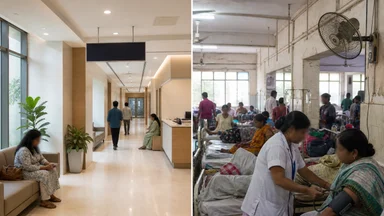
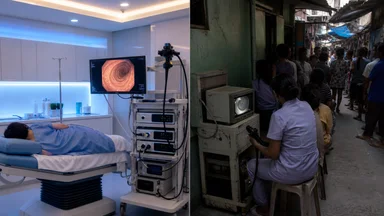
Even when a younger adult does see a gastroenterologist, getting an endoscopy can take months. Endoscopy units across Japan operate at or near capacity, and a large share of that capacity is consumed by patients aged 60 and older who return every one to two years for surveillance of previously detected lesions, such as atrophic gastritis or intestinal metaplasia, which carry an elevated risk of progression to cancer. This practice is evidence-based; the risk of progression is real, and periodic surveillance has been shown to catch early cancers that can be removed endoscopically. But it also means that scopes, endoscopists, and sedation slots are tied up with follow-up exams, leaving less room for initial diagnostic workups in symptomatic younger patients.
Waiting times reflect the crunch. In urban centers like Tokyo and Osaka, a non-urgent endoscopy for a new patient can be booked four to six weeks out, but in some regional hospitals, waits stretch to two or three months. For a younger patient with alarm symptoms like weight loss or anemia, the wait is shorter, but for those with vague dyspepsia, the delay can be considerable. A 2024 survey by the Japan Gastroenterological Endoscopy Society reported that the median wait for a non-urgent endoscopy was 30 days, with significant variation across facilities.
The capacity problem is not just about the number of scopes; it is about the number of endoscopists. Japan has a high density of gastroenterologists per capita, but many are concentrated in academic centers and large hospitals, leaving rural and suburban areas underserved. Nurse-led screening programs, which have been proposed as a way to triage younger patients using non-invasive tests, are still rare. The result is a system that, by default, prioritizes the older, already-diagnosed population, while younger patients with new symptoms wait.
There is an equity dimension here. Younger adults are more likely to be working, often without the flexibility to take time off for a procedure that requires a day of recovery. They may also be less likely to seek care for symptoms they attribute to stress or diet. When they do, the system's queues can discourage persistence. A 2022 qualitative study of Japanese adults under 50 with dyspepsia found that many delayed endoscopy for months, citing work commitments and the perception that their symptoms were not serious enough to warrant the wait.
The Evidence Gap: Age Thresholds vs. Infection Burden
A landmark randomized trial in China, published in the New England Journal of Medicine in 2021, showed that one-time H. pylori screening and eradication therapy reduced gastric cancer incidence by 18% and mortality by 34% over a median follow-up of 7.5 years. In Japan, where the baseline incidence is higher, the benefits could be greater. Meta-analyses of observational studies estimate that H. pylori eradication reduces gastric cancer risk by roughly 30–50%, with the effect strongest when treatment is given before the development of premalignant lesions.
Japan's national program, however, has not incorporated H. pylori testing. The 2024 revision of the guidelines, issued by the Japanese Society of Gastroenterology, did recommend H. pylori testing and eradication for patients with peptic ulcer disease and for those with confirmed infection, but it stopped short of endorsing population-wide screening for younger adults. The rationale for caution is partly economic: screening everyone under 50 for H. pylori would require significant investment, and the number of infections is declining, so the cost-effectiveness is uncertain.
International guidelines offer a contrast. The European guidelines on management of precancerous conditions and lesions in the stomach, published in 2019, recommend a risk-based approach, stratifying patients by H. pylori status, family history, and endoscopic findings. The Maastricht VI/Florence consensus report, also from 2022, advocates for H. pylori testing and eradication in all first-degree relatives of gastric cancer patients, regardless of age. Japan, despite its high burden, has been slower to adopt these recommendations, partly because its national program is organized around age-based screening and partly because of the entrenched belief that gastric cancer is a disease of the elderly.
The gap between evidence and practice is narrowing, but not fast enough. Several cost-effectiveness models, including one from the National Cancer Center Japan, have suggested that a risk-based strategy combining H. pylori serology and family history could be cost-effective, if not cost-saving, compared to the current age-based program. But these models rely on assumptions about adherence and the cost of endoscopy, which vary widely across regions. Until the national program changes, the default remains a system that screens by age, not by risk.
Why Clinicians Keep Referring Seniors First
The inertia in the system is not just a matter of policy. Clinicians, too, are shaped by training, reimbursement, and the fear of missing a cancer in a high-risk patient. Older adults have a higher absolute incidence of gastric cancer, so a 70-year-old with dyspepsia is more likely to have a significant lesion than a 40-year-old with the same symptom. This Bayesian logic drives referral patterns, even when the younger patient has additional risk factors like H. pylori positivity or a family history.
Reimbursement reinforces the bias. Japan's national health insurance system pays for endoscopy based on a fee schedule that does not differentiate by age, but it does require a documented clinical indication. For older patients with prior findings, the indication is clear: surveillance of a known lesion. For a younger patient with dyspepsia and no prior findings, the indication is vaguer, and some insurers may question the necessity. This creates a subtle incentive for clinicians to prioritize the older patient whose procedure is more likely to be approved. A 2023 analysis of claims data from the JMDC database, published in the Journal of Gastroenterology, found that the rate of endoscopy for dyspepsia in patients under 50 was roughly one-third the rate in patients over 70, even after adjusting for comorbidities and healthcare utilization. The authors noted that this difference could not be explained by clinical factors alone, suggesting that reimbursement policies and physician practice patterns play a significant role.
Medico-legal pressures also play a role. Japanese physicians face a low but real risk of litigation for missed cancers, and following established guidelines offers protection. When guidelines say screening starts at 50, a physician who declines to scope a 55-year-old is at risk; a physician who scopes a 45-year-old is not, but neither is there a strong mandate to do so. The path of least resistance is to follow the age-based protocol, which in practice means that younger patients are less likely to be referred for endoscopy unless they have clear alarm symptoms.
Habit and training complete the picture. Many gastroenterologists trained in an era when gastric cancer was overwhelmingly a disease of the elderly, and their clinical instinct reflects that. They may not be aware of the latest data on early-onset cases, or they may view them as outliers. Changing this mindset requires more than a guideline revision; it requires education, audit, and a shift in the default referral pattern.
Early-Onset Gastric Cancer: A Silent Shift
The rise in early-onset gastric cancer is not unique to Japan. A 2023 study in Gastroenterology analyzing global trends found that the incidence of gastric cancer in adults under 50 has increased in many countries, including the United States, where the absolute numbers are small but the trend is clear. In Japan, the increase is more pronounced, likely because of the high baseline prevalence of H. pylori in older cohorts and the persistence of the infection in younger ones.
Early-onset gastric cancer tends to be biologically different from the disease in older adults. It is more often of the diffuse type, which spreads along the stomach wall without forming a discrete mass, making it harder to detect on endoscopy. It is also more likely to be diagnosed at an advanced stage, partly because younger patients and their physicians often attribute symptoms to stress, gastritis, or gastroesophageal reflux. A 2021 study from the University of Tokyo found that the median time from symptom onset to diagnosis in early-onset cases was 6 months, compared to 3 months in older patients.
The symptoms themselves are vague: dyspepsia, bloating, early satiety, and sometimes mild epigastric pain. These are common complaints in any gastroenterology clinic, and most turn out to be functional dyspepsia or peptic ulcer disease, not cancer. But the occasional gastric cancer in a 38-year-old is easy to miss, and the consequences are severe. The five-year survival for stage IV gastric cancer is under 10%, even with modern chemotherapy, whereas stage I disease is curable in over 90% of cases.
There is no national screening program for this age group, so detection relies on opportunistic endoscopy. A clinician who suspects cancer in a young patient will order a scope, but the threshold for suspicion is higher, and the wait times are longer. The combination of a low index of suspicion and a strained system creates a perfect storm for delayed diagnosis.
Pilot Programs and Risk-Based Screening Trials
In response to these trends, several municipalities and prefectures have begun testing risk-based approaches. One of the most prominent is the Fukui Prefecture program, which since 2019 has offered H. pylori antibody testing to residents aged 40 and older, and refers those who are positive for endoscopy. The program has enrolled over 30,000 participants, and preliminary results, presented at the 2024 meeting of the Japan Gastroenterological Endoscopy Society, show a detection rate of gastric cancer of 0.4%, comparable to the rate in the older age-based screening group.
Other pilots have focused on family history. The National Cancer Center Japan is running a trial that screens first-degree relatives of gastric cancer patients, regardless of age, with H. pylori testing and endoscopy. The trial, which began in 2022, has enrolled over 2,000 participants and has identified several early-stage cancers that would otherwise have been missed. The findings are not yet published, but interim analyses suggest that the yield is high enough to justify expansion.
Cost-effectiveness analyses are ongoing. A 2025 modeling study from Kyoto University estimated that a risk-based strategy, targeting H. pylori-positive adults aged 40 to 49, would cost an additional ¥3.2 million per quality-adjusted life year gained, compared to the current program. That figure is below Japan's threshold for willingness to pay, which is often cited as around ¥5 million per QALY. The same study found that adding family history to the risk criteria improved the cost-effectiveness further.
Despite these promising results, national rollout remains uncertain. The Ministry of Health has not committed to a timeline for revising the screening guidelines, and some officials have expressed concern that a risk-based approach could exacerbate disparities if not implemented carefully. There is also the practical question of how to identify H. pylori-positive younger adults, since routine testing is not currently covered by insurance. The pilots have used research funding, but scaling them would require a new reimbursement code.
Rethinking Triage: Who Gets the Next Scope?
Given the finite supply of endoscopy slots, the question is not whether to screen younger adults, but how to do so without displacing older patients who are at high risk. One answer is to use non-invasive tests to triage. H. pylori serology is cheap and widely available, and a positive result, combined with age and family history, could identify younger adults who warrant endoscopy. This is the approach used in the Fukui pilot, and it has the advantage of being scalable.
Another option is to expand capacity by shifting some surveillance to nurse-led programs. In many hospitals, endoscopists perform both diagnostic and therapeutic procedures, but surveillance of low-risk lesions, such as small atrophic patches, could be done by trained nurses under supervision, freeing up physician time for new patients. This model has been piloted in a few academic centers, with reported success in reducing wait times for initial endoscopy.
There is also the possibility of using biomarkers other than H. pylori. Serum pepsinogen levels, which reflect gastric mucosal atrophy, have been used in some screening programs, and newer tests, such as microRNA panels, are in development. These are not yet ready for routine use, but they could eventually provide a non-invasive way to stratify risk in younger adults.
However, risk-based screening is not without potential downsides. Critics point to the risk of overdiagnosis: identifying and treating H. pylori infections that would never progress to cancer could lead to unnecessary antibiotic use and associated side effects. There is also the psychological toll of a positive H. pylori test, which may cause anxiety in otherwise healthy individuals. Moreover, a risk-based approach could inadvertently widen disparities if younger adults with lower health literacy or limited access to care are less likely to participate. A 2024 commentary in the Journal of Gastroenterology argued that any shift away from universal age-based screening must be accompanied by robust public education and outreach to ensure equity.
Aligning guidelines with the infection burden will require a cultural shift as well as a policy one. The Japanese Society of Gastroenterology has recommended H. pylori testing for younger adults with a family history, but it has stopped short of endorsing universal screening. The next revision of the national guidelines, expected in 2026 or 2027, will be watched closely. If it incorporates risk-based criteria, it could reshape the way gastric cancer is prevented in Japan, but it will also raise difficult questions about resource allocation and equity.
In the meantime, clinicians are left to navigate the gap between what the evidence suggests and what the system supports. A 45-year-old with H. pylori infection and a family history of gastric cancer may still face a two-month wait for an endoscopy, while a 70-year-old with a small atrophic patch can get a scope within weeks. That is not a judgment on the value of either patient; it is a reflection of a system designed for a different era. To address this, the Japanese Society of Gastroenterology should issue a formal recommendation that all adults under 50 with H. pylori infection and a first-degree relative with gastric cancer be referred for endoscopy, regardless of symptoms. Additionally, the Ministry of Health should pilot a risk-based screening program in two or three prefectures, with a clear evaluation framework, to generate the evidence needed for a national rollout. Only by shifting the default from age to risk can Japan ensure that its most valuable resource, the endoscope, reaches those who need it most.
This article is for informational purposes only and is not a substitute for professional medical advice. Consult a qualified clinician for personalized guidance.